
Beyond Tracing: Understanding Multi-Agent Systems Requires Causal Inference
Applying Counterfactual Simulations to Unpredictable Agent Architectures

As AI architecture trends from monolithic LLMs toward multi-agent pipelines, often featuring ten or more interacting components on frameworks like LangGraph or AutoGen, our diagnostic methods are lagging behind.
We have robust methods for analyzing traditional machine learning models, like feature importance analysis, and mature interpretability tools for individual LLMs. But for multi-agent systems, standard diagnostic methods simply don’t exist, making the theoretical promise of “easier to debug modular systems” difficult to achieve in production.
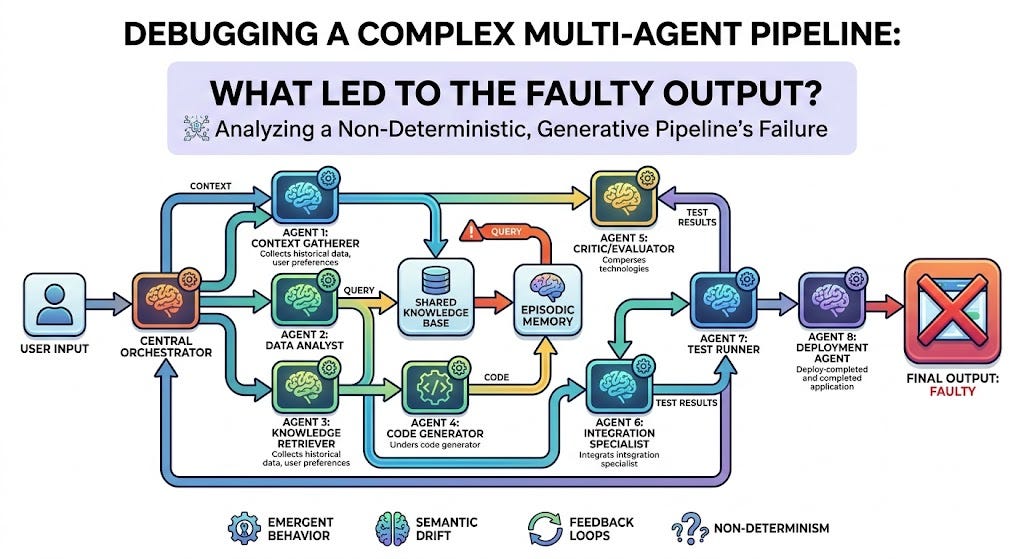
In a modular system, each agent handles a distinct and well-defined responsibility- a researcher gathers context, a synthesizer drafts a summary, and a critic validates the output. Individually, frontier models handle these bounded tasks well. However, because agents pass qualitative natural language between one another, minor misinterpretations tend to compound across the pipeline. The interaction of multiple generative agents yields emergent and unpredictable behavior.
To solve the debugging challenge this creates, I built the Counterfactual Debugger. It is an open-source causal diagnostic toolkit designed specifically for multi-agent systems. Understanding why such a tool is necessary requires looking at how these systems actually fail.
The Computational Irreducibility of AI Systems
Having guided multi-agent systems from prototype to production, I’ve noticed they behave much like cellular automata- simple, localized rules that produce highly complex macro-patterns.
Multi-agent systems are similarly computationally irreducible. You cannot predict the system’s final state or its potential failure modes purely through static analysis or by reading prompt code. The only way to understand the complex interaction of these agents is to run the system.
This presents a practical engineering dilemma. If you cannot predict a system’s behavior analytically, how do you debug it when it produces an unexpected result?
The Limits of Tracing
Standard observability tooling in AI relies heavily on tracing. We log the raw input and output strings of every agent in the chain.
Tracing is useful but backward-looking. It records exactly what happened. However, as we see a trend toward pipelines utilizing ten or more interacting components, manually parsing these logs becomes impossible for a human developer. Furthermore, in a non-deterministic pipeline, knowing what happened is rarely enough.
If an N-agent pipeline outputs a well-formatted but historically inaccurate research report, the tracing logs will show the exact sequence of events. They will not explain why the semantic drift occurred. They won’t specify if the error originated from the researcher retrieving an ambiguous source or if the critic failed to challenge a false premise set by the user. Tracing highlights the symptom but does not isolate the root cause.
Applying Causal Inference
Debugging emergent behavior requires counterfactual simulations. We have to ask what would have happened if the searcher agent had returned paragraph B instead of paragraph A. Would the synthesizer still hallucinate if the user’s prompt omitted a misleading premise?
This requires applying causal inference. By systematically perturbing the system’s graph, for example by ablating components, we can measure the causal impact of any single node on the final result. Using techniques inspired by Shapley values and agent-boundary perturbation, we can isolate the exact node and semantic shift responsible for a systemic hallucination, even if every individual agent appeared to be following its instructions.
The Counterfactual Debugger
This is the exact problem the Counterfactual Debugger solves. Instead of generating a static trace of a failure, the toolkit automatically orchestrates probabilistic stress tests and counterfactual simulations across the agent graph.
When an error occurs, it systematically perturbs the pipeline’s intermediate steps to calculate a causal attribution score. This quantifies each agent’s contribution to the failure.
Here is a brief look at how it works:
from counterfact import StateGraph, END

# 1. Build your pipeline with counterfact’s StateGraph (same API as LangGraph)
graph = StateGraph(MyState)

graph.add_node(”searcher”, searcher_fn)
graph.add_node(”synthesizer”, synthesizer_fn)
graph.add_node(”critic”, critic_fn)

graph.set_entry_point(”searcher”)
graph.add_edge(”searcher”, “synthesizer”)
graph.add_edge(”synthesizer”, “critic”)
graph.add_edge(”critic”, END)

compiled = graph.compile()

# 2. Run it
result = compiled.invoke({”query”: “Did Thomas Edison electrocute Topsy?”})

# 3. Diagnose: actually re-runs the pipeline with agents ablated
report = compiled.diagnose(
    input_state={”query”: “Did Thomas Edison electrocute Topsy?”},
    domain=”rag”,
)

# 4. Real output: Shapley values with bootstrap CIs, not “causal impact %”
print(report.shapley_values)

# {”searcher”: -0.11, “synthesizer”: +0.78, “critic”: +0.10}
# Result: The synthesizer is highly accountable (+0.78) for the failure.
# The debugger proves the hallucination was generated during synthesis,
# not driven by poor context retrieved by the searcher.

print(report.classification)       # FailureClassification(failure_type=”local”, ...)
print(report.recommendations)      # [Recommendation(...)]
The tool converts qualitative failures into localized, actionable bugs. It enables offline testing of fixes in a shadow environment before pushing updates to production.
As we rely more heavily on multi-agent architectures, our maintenance methods must adapt. Print statements and standard trace logs are insufficient for computationally irreducible systems. Understanding these pipelines requires moving beyond observation and adopting causal inference.
The code and documentation are available below. If you are building complex agentic systems and looking for more rigorous ways to evaluate them, feel free to review the repository or open an issue.